
B2(中上級) · 🔬 科学 · 342語 · 約3分
Why We Forget: The Forgetting Curve and Spaced Repetition
人はなぜ忘れるのか ― 忘却曲線と分散学習の科学
覚えたはずの知識が時間の経過とともに消えていくのはなぜか。エビングハウスの忘却曲線のしくみと、記憶を定着させる「分散学習(スペースド・レピティション)」の効果を科学的に解説します。
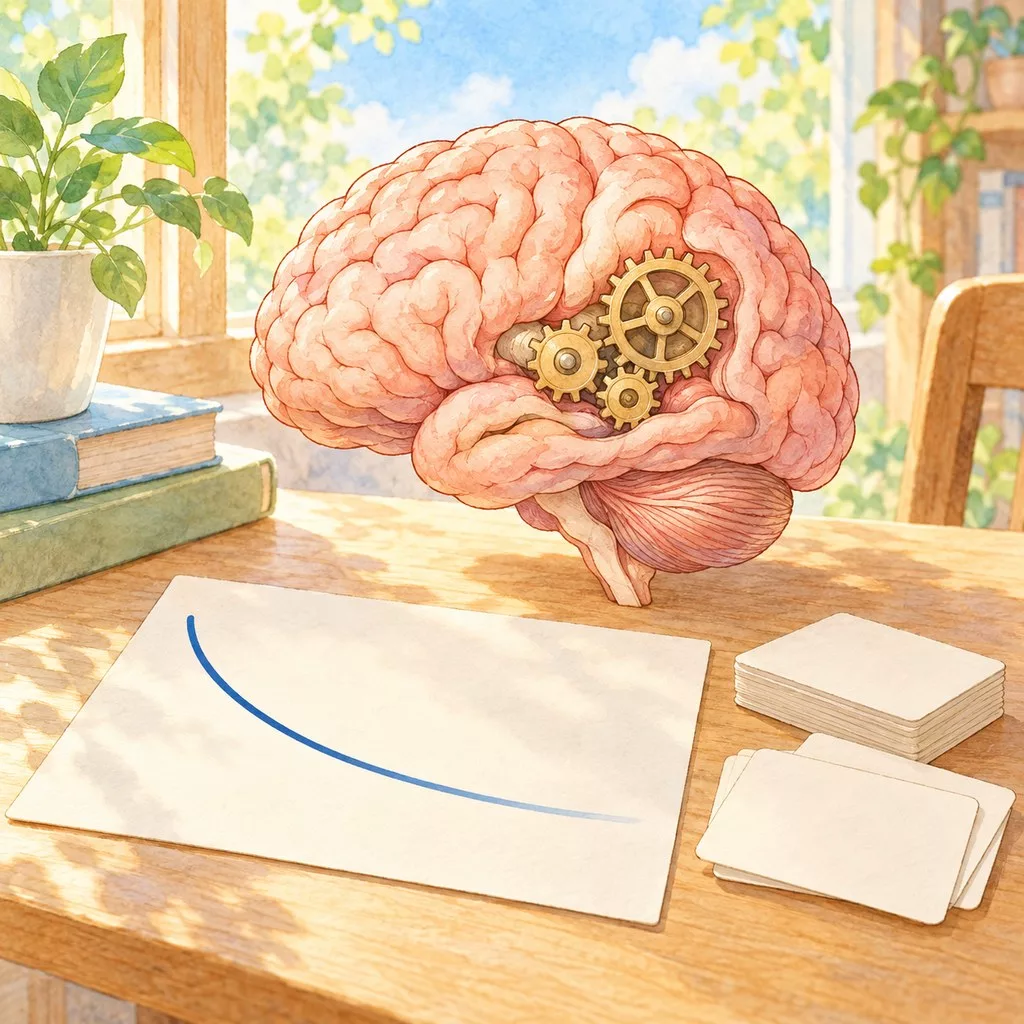
Have you ever spent hours for an important exam, only to find yourself struggling to recall the facts a few weeks later? This frustrating experience is not a sign of poor intelligence, but rather a fundamental feature of human brain . Our memory systems are designed to filter out stimuli so that vital information can be prioritized.
In the late nineteenth century, German psychologist Hermann Ebbinghaus conducted research to measure how memory fades over time. To eliminate the influence of prior knowledge, he tested himself by memorizing extensive lists of nonsense syllables. By recording his at various intervals, Ebbinghaus plotted what is now famously known as the forgetting curve. His findings revealed that forgetting occurs most immediately after learning, with much of the newly acquired material lost within twenty-four hours. After this initial rapid decline, the rate of loss slows considerably over subsequent days and weeks.
Why does the brain discard newly acquired information so readily? From an , storing every single sensory detail would overload our cognitive capacity and impair decision-making. Neural connections that are not actively reinforced are thought to weaken through a natural process. In other words, the brain assumes that facts used only once are inconsequential and safely .
Fortunately, cognitive researchers discovered a powerful against this decay, known as spaced repetition. Instead of massing study time into a single exhausting session, learners review material across of time. Each time an individual successfully a fact just as it begins to slip away, the memory is strengthened. Consequently, the slope of the forgetting curve flattens, enabling memories to transition from short-term storage into durable long-term retention.
Modern digital applications leverage this phenomenon by automatically scheduling flashcard reviews according to each learner's recall performance. Research confirms that spaced retrieval practice generally outperforms passive re-reading or highlighting. Understanding the science of forgetting reminds us that effective learning is not about endless cramming. By embracing timed reviews, we work our natural biology to build knowledge that truly lasts.
理解度チェック(4問)
1. エビングハウスの研究で、記憶の忘却が最も急激に起こるのはいつであることが明らかになりましたか?
2. 脳が一度しか使われない情報を忘れるのは、認知容量の過負荷を防ぎ適切な意思決定を保つための進化上の特徴である。
3. 「分散学習(spaced repetition)」の復習方法として適切なものはどれですか?
4. この記事全体の中心的なメッセージとして最もふさわしいものはどれですか?
最後まで読んで、理解度チェックに答えると「読み終わった」になります(0 / 5 段落)